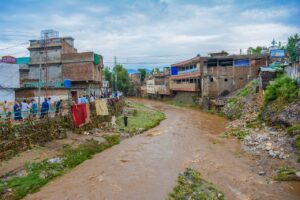
In fragile and transitional regions, young people face overlapping barriers that make education not only hard to access, but often disconnected from their realities.
Displacement, conflict, economic pressure, and chronic underinvestment have left many school systems stretched thin. Teachers work without resources, students cycle in and out of disrupted schooling, and traditional curricula fail to reflect the demands of a fast-changing, digital world.
Yet inside every classroom, there’s a powerful lever for change – the teacher.
The Case for Teacher Transformation
Investments in school buildings, new policies, or digital devices may look like progress – but without skilled, future-ready educators, they rarely lead to lasting impact.
Teacher transformation is not a side strategy. It’s the foundation.
We believe that training a teacher doesn’t just improve lessons – it multiplies the impact of every other educational reform. Teachers are the human infrastructure of education systems. They are the direct link between policy and practice, hope and opportunity.
That’s why Phoenix Space is putting teacher transformation at the center of its developmental blueprint.
What Kind of Teachers Are Needed Now?
In fragile regions, the role of the teacher must expand. We need educators who are:
- Digitally Fluent – Using AI tools, blended strategies, and online platforms to reach learners even in low-resource settings.
- Future-Skills Oriented – Teaching not just literacy and numeracy, but problem-solving, coding, and entrepreneurial thinking.
- Context-Adaptive – Navigating disrupted classrooms, conflict zones, or rural areas with creativity and resilience.
- Mentors and Guides – Supporting learners’ psychosocial needs and helping them imagine meaningful futures.
These are not abstract ideals – they are urgently needed in educational systems all over the world.
A Glimpse Into the Work
In 2025, Phoenix Space piloted a teacher training initiative in Southeast Asia that introduced a new way of thinking about education delivery. The goal wasn’t to replace what already exists, but to support educators in exploring:
- Practical AI tools for personalized learning
- Interactive STEM modules rooted in real-world problem solving
- Human-centered design for lesson planning in diverse contexts
What made the pilot effective wasn’t just the technology – it was the recognition that teachers are agents of transformation, not passive recipients of reform.
Why It Matters
Across the fragile regions where we work, young people face interrupted schooling, outdated content, and shrinking prospects. But these challenges are not insurmountable.
By transforming the teaching profession, we can close the developmental gap in one generation – not just by delivering content, but by equipping educators to rebuild confidence, spark creativity, and guide learners toward real futures.
A Call to Funders and Policymakers
If you’re investing in education in crisis-affected regions, don’t overlook the single most powerful multiplier: the teacher.
Support programs that center educators as innovators and mentors. Invest in digital training that is relevant and practical. Back initiatives that are built from within – grounded in local expertise, not flown in from outside.
Because when teachers transform, everything else follows.